
 Home — Continuous Improvement Tools
Process Improvement Tools.
Standard Work.
Work Instructions.
Flow Chart templates.
Swim Lane Cross Functional Flowchart.
Value Stream Mapping.
Lean tools.
Time Study templates.
DMAIC tools.
Quality Improvement tools.
House of Quality QFD.
FMEA Risk Reduction.
Root Cause Analysis tools.
Problem Solving tools.
OEE.
Preventive Maintenance.
Skip to main content


Office Examples







Installation and Setup
Installation - Each User. Installation - Multi-user. Language Translations. Personalize Your Templates.Systems2win Training.
Quick Start Initial Training. New User Training. Training Matrix. Systems2win Leadership. Training Classes.Lean Training
Lean Training and Coaching. Lean Principles. Muda 8 Wastes. Goal - Lean Flow. Roadmap - Lean Journey. Value Stream Mapping. Standard Work. Hansei Lean Thinking. Lean Dictionary. Online Lean Training. Lean Leadership.Microsoft Office Training
Excel Training. Excel Drawings (without Visio). Excel Charts. Word Training. PDF Training. Document Storage and Naming.Support
Support.Muda — 7 Wastes of Lean
The 7 Deadly Wastes (muda)
as defined by Taiichi Ohno (Toyota executive, 1912-1990)
- Defects
- Overproduction of things not demanded by actual customers
- Inventories awaiting further processing or consumption
- Unnecessary extra processing (for example, relying on inspections rather than designing the process to eliminate problems)
- Unnecessary motion of employees
- Unnecessary transport and handling of goods
- Waiting for an upstream process to deliver, or for a machine to finish processing, or for a supporting function to be completed, or for an interrupted worker to get back to work...
8 Types of Waste
In recent years, various authors and experts
have expanded the list to their own version of
'the 8 Wastes of Lean',
with the 8th waste being one of the following:
- Under utilized human potential — skills, talents, and creativity
- Unsafe or unergonomic work conditions
- Confusion — any uncertainty about the right thing to do.
8 Wastes of Lean: Downtime
If you speak English, then
this Downtime Acronym might help you remember the 8 Deadly Wastes
Defects
Overproduction
Waiting
Non Value Add Extra Processing
Transportation
Inventory
Motion
Eschewed Talents (Under utilized Employees)
If English is not your preferred language, then see our instructions for how to translate all of your Systems2win lean training into any language.
Muda, Mura, and Muri
Muda = waste (in its many forms)
Muda waste is often accompanied or caused by...
Mura = unevenness, overburden, strain
Muri = demand that exceeds process and equipment capacities
"The most dangerous kind of waste is the waste we do not recognize." ~ Shigeo Shingo
Office Examples
of the Muda 7 Types of Waste
Office Examples of the 8 Wastes of Lean
Defects
Products, services, or information that are wrong, incomplete, or late
Office examples: Data entry errors. Missing information. Other types of order entry or invoice errors. Any error that gets passed downstream — only to be returned for correction or clarification. Engineering change orders. Design flaws. Employee turnover. Absenteeism.
Overproduction
Making too much, or too soon
Goal = Deliver exactly what the customer wants exactly when wanted.
Office examples: Printing extra copies. Printing paperwork (that might change) before it is needed. Processing an order (that might change) before it is needed. Storing extra copies in redundant filing systems. Emails to people that don't need to be cc'd.
Waiting
Waiting for anything... tools, equipment, materials, people...
Office examples: Slow computer speed. Downtime (computer, fax, phone...). Waiting for approvals. Waiting for information from customer. Waiting for clarification or correction of work received from an upstream process.
Non Value Add Processing
Any process steps that do not add value — from the perspective of the customer
Relying on inspections, rather than designing the process to eliminate errors. Extra information. Re-entering data into multiple information systems. Making extra copies. Generating unused reports. Expediting. Unnecessarily cumbersome processes (think financial statement period end close, expense reporting, the budget process...)
Transportation and Handling
Any unnecessary movement of the thing being processed
Office examples: Movement of paperwork. Multiple handoffs of electronic data. Approvals. Excessive email attachments. Distributing unnecessary cc copies to people who don't really need to know.
Inventories
Piles of anything. Parts, supplies, emails, paperwork, archives...
Purchasing or making things before they are needed (think office supplies, literature...). Things waiting in an (electronic or physical) In Box. Unread email. Any form of batch processing (maybe transactions, reports...)
Motion
Any unnecessary movement of human workers
Walking to copier, printer, fax... Walking between offices. Central filing. Searching for missing information. Shifting back & forth between computer screens. Scrolling up and down computer screens. Shuffling through papers.
Eschewed Human Potential
To eschew means
"to purposely avoid"
Employing only people's backs, and not their minds.
Restricting employee's authority and responsibility to make routine decisions. Having highly paid staff do routine tasks that don't require their unique expertise. Not providing the business tools needed to perform and continuously improve each employee's assigned work. Not trusting your people to stop production to stop and fix a problem (jidoka). Not trusting your people to be responsible for the cleanliness, maintenance, and organization of their own work area. Not trusting people with a flat organization structure of largely self-directed teams. Not expecting (and measuring) every person to contribute to continuous improvement.
Unsafe or unergonomic work conditions.
Anything that has potential to harm anyone. Office work conditions that cause carpel tunnel, eye fatigue, chronic back pain... Conditions that compromise the health and productivity of workers in any way.
Confusion. Anything that causes uncertainty about the right thing to do.
Confusing goals. Confusing metrics. Confusing instructions. Missing pieces. Lack of training, coaching, support. Missing or confusing systems.
See more training for Lean Office
How to eliminate the 7 forms of waste
Use your templates
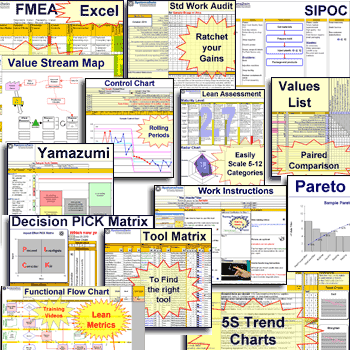
Use your 150+ continuous improvement templates
- Lean tools
to make any process better, faster, cheaper
- Root Cause Analysis
These types of waste are not direct targets for continuous improvement. They are symptoms. You need to eliminate root causes.
- Six Sigma templates
to solve quality problems
- Value Stream Mapping templates
for strategic alignment
- Lean Management Systems
for lean leadership
Consistently-designed Word and Excel templates — with online training for dozens of field-proven lean methods
to identify and eliminate deadly wastes
Use your online training
- Lean Objectives and Ideals
- The PDCA scientific method
- The Lean 4 Rules In Use
- Hansei: Reflect, Ponder, Think
- Kaizen and Lean Training home page
Why re-invent?
Muda: Type one vs. type two
Waste is further categorized as:
1) Type one muda — pure waste
Pure waste. Adds no value and can be eliminated immediately.
"That's embarrassing. Let's stop doing that."
2) Type two muda — non value add
Adds no value, but is required for the way things are currently done.
Examples: inspection, paperwork, and most of the above types of deadly waste
Also see the definition and training for 'Value Add Time'
in the online lean dictionary
that ensures that all of your widespread team members are using the same definitions, formulas, and understandings of lean terminology as they use their tools for process improvement
User-defined types of waste
In addition to the classic deadly 7 types of waste,
several of your Systems2win templates also empower you to enter your own user-defined subcategories
that your team finds most useful for analyzing the unique types of waste found in YOUR process
See the online training for your
- Process Observation template (Observation.xlsx)
- Yamazumi template (Yamazumi.xlsx)
- Standard Work template (StdWork.xlsx)
- Value Stream Mapping template (VSM.xlsx)


How to use your
Lean Waste Walk template
aka Waste Walk template, 8 Wastes template, or 7 Wastes template
Find and open your template
Find and open your Muda Waste Observation template (ObserveMuda.xlsx)
in the same way that you find and open your other 150+ Systems2win templates.
If you don't yet own a license, you can download your free muda template now.
(and this Muda template has no expiration — you can use it for the rest of your career as a free gift)
Save your working document
following the usual document storage and naming conventions established by your leaders
Open a Blank Sheet
When you're ready to start doing your own real work...
click the button to 'Open a Blank Sheet'
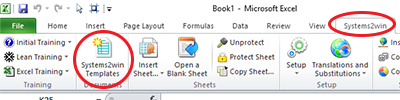
Excel Ribbon bar > Systems2win tab > Open a Blank Sheet
This blank sheet is where you will do your real work
(not on the Sample sheet — which gives you sample data that is extremely helpful for learning how to use your new tool, but is the wrong place to do your real work)
Rename your new sheet.
Or... Insert Sheet
As an alternative to opening a stand-alone document (as instructed above),
you also have the option to Insert Sheet into any other Excel workbook.
If English is not your preferred language
Switch to your language, just like every Systems2win Excel template.
Now you are ready to start observing
Muda Lean Waste
Print your Muda Observation sheet
Muda observation must be done at the gemba
(the place where the work is performed)
Although some very computer-oriented people might prefer to enter their observations directly into their laptop or pad computer...
it is much more common to hand write your observations on your printed form.
You'll get a lot more out of this training if you have your template open in front of you
See the Help and Sample sheets for examples, learning exercises, pop-up help, Excel tips, and other training aids
Observe
There are many ways to observe waste. Here are two popular methods.
Option 1) Stand in a Circle
Your sensei uses chalk to draw a circle on the floor, and gives you the instruction to stand in that circle for a specified amount of time (perhaps a half hour, perhaps a half day...)
and then discuss the types of waste that you observe, and your ideas for how to reduce the wastes you observe.
Option 2) Waste Walk
Launch your team
using the same tools and systems that you use to launch every process improvement team.
Train your people
using the training on this page, and your Muda template.
Ensure that everyone is very clear about your Operational Definitions for what is and is not waste,
perhaps using your Operational Definitions template. (Op_Def.xlsx)
Observe
Usually in pairs.
Be sure to follow the common courtesies taught for any type of Process Observation.
Discuss
Return to the group, and facilitate discussion about what was observed, and ideas for how to reduce wastes.
Lay out a Plan
Make a plan to implement your chosen counter-measures.
You could add columns to your Muda template
perhaps columns for Ideas, Approvals, Validation, etc.
but it is usually wiser to use one or more of your other templates to follow up with each of your chosen counter-measures.
Perhaps use your...
- Event Action List (EventAction.xlsx)
- Team To Do List (ToDo.xlsx)
- Bowling Chart (BowlingChart.xlsx)
- Value Stream Plan (vsmPlan.xlsx)
- or any of your other usual Lean Management Systems
Get Results
If you're not going to follow up to get results,
then why start?
Return to Quick Start Training to quickly learn how to start using your new templates to identify and eliminate the deadly 8 wastes in your processes
Contents
Training and Coaching
Consider Training and Coaching to support your teams to succeed
Training to get you started.
Tools you won't outgrow.
Schedule a Conference
Schedule a conference
to discuss your challenges
with an experienced lean advisor