
 Home — Continuous Improvement Tools
Process Improvement Tools.
Standard Work.
Work Instructions.
Flow Chart templates.
Swim Lane Cross Functional Flowchart.
Value Stream Mapping.
Lean tools.
Time Study templates.
DMAIC tools.
Quality Improvement tools.
House of Quality QFD.
FMEA Risk Reduction.
Root Cause Analysis tools.
Problem Solving tools.
OEE.
Preventive Maintenance.
Skip to main content


Installation and Setup
Installation - Each User. Installation - Multi-user. Language Translations. Personalize Your Templates.Systems2win Training.
Quick Start Initial Training. New User Training. Training Matrix. Systems2win Leadership. Training Classes.Lean Training
Lean Training and Coaching. Lean Principles. Muda 8 Wastes. Goal - Lean Flow. Roadmap - Lean Journey. Value Stream Mapping. Standard Work. Hansei Lean Thinking. Lean Dictionary. Online Lean Training. Lean Leadership.Microsoft Office Training
Excel Training. Excel Drawings (without Visio). Excel Charts. Word Training. PDF Training. Document Storage and Naming.Support
Support.Catchball
A lean system to greatly improve bidirectional feedback and ownership. Especially for complex decision making and policy deployment!
Playing catchball ensures that everyone who should give input, does.
And ensures that everyone is committed to doing what everyone agreed to.
"Catchball" is a phrase that we first saw in the book Value Stream Management for the Lean Office, by Don Tapping and Tom Shuker.
To quote from that (highly-recommended) book:
"Catchball is simple. Regardless of who initiates a project (although it's most commonly a manager), that person articulates the purpose, objectives, and other ideas and concerns and then ‘throws' them to the other stakeholders for feedback, support, and action.
In value stream management, the catchball process essentially begins as soon as a manger assembles a core implementation team and identifies an area to improve. Based on the purpose, objectives, and concerns communicated by the manager, the team completes a team charter that defines the project in more detail and then throws it back. Catchball is also used to reach agreement on the future-state map, and kaizen plans."
Why is catchball so essential for lean success?
Because it is a systematized, teachable, repeatable way to:
- Confirm the practicality of proposed plans. (and their probability of success)
- Actively solicit (and often act upon) feedback and ideas from the "lower" level people
that are responsible for actually implementing the plans. - Greatly improve wide-spread understanding of what needs to be done, why, and how.
- Greatly improve ownership and buy-in from the people responsible for results.
- Demonstrate and encourage non-dictatorial leadership skills
for all levels of executives, managers, supervisors, and team leaders.
When to use catchball?
Any time that any of the above is important.
Any time that a higher level planning team is asking others to implement their plans.
Catchball is especially recommended for value stream mapping, supply chain management, and hoshin strategic planning.
Catchball in Hoshin Planning
Catchball is absolutely essential for Hoshin Kanri Policy Deployment.
1. Prepare for the meeting
Preparation for each catchball meeting might involve:
- Hire a skilled facilitator
- Establish Ground Rules for Working Together
- Use your Agenda & Minutes template
to prepare for & record results of the meeting - Prepare the room and healthy refreshments
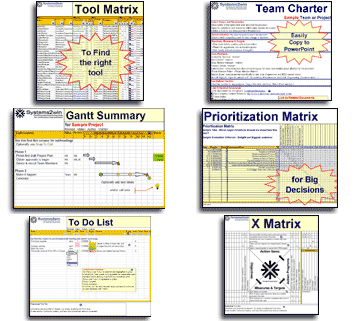
- Distribute copies of the X Matrix and Team Charter
- Use Change Management tools to prepare in advance for the possible concerns of diverse stakeholders
2. Introduce the proposed X Matrix plan for the next-higher level(s)
patiently explaining each section to any new-comers to Hoshin Planning and making it clear that each Action Item on the next-higher X Matrix represents an improvement project
and that each designated team leader is responsible for creating a Team Charter, and will be held accountable to accomplish their agreed-upon assignments and Strategic Targets.
3. Introduce the proposed Team Charter for this team
Discuss & clarify the plan
documenting any reservations or improvement suggestions, which will be reviewed by the next-higher-level team, which might then revise their X Matrix based on the feedback.
This mechanism for front-line feedback can be truly revolutionary for organizations accustomed to top-down strategic planning.
4. Begin to create
Begin to create the X Matrix and Project Plans for this level of deployment.
Begin to create suggested Team Charters for the next-more-detailed level of deployment.
Allow time for training, questions, concerns, and discussion.
Click image to learn more
5. Allow time to ponder and reflect
Allow time for the team to ponder and reflect.
Allow time for the team to complete any research and analysis needed to support a commitment to the proposed targets in the next-higher plan.
Allow time for the team to perhaps play their own rounds of catchball with the next-lower teams.
Allow time for the next-higher team to perhaps adjust their plan based upon feedback.
6. Finish documenting plans for this team
Finish completing the X Matrix, Team Charter, and Project Plans for this team, as well as proposed Team Charters for the next-level teams accountable to complete the Action Items on the this-level X Matrix.
And then once catchball has been played all the way down to the Action Teams...
7. It reverses direction
and there is a round of catchball where each team responds to feedback from each of their chartered Teams, and prepares final changes to propose to the next-higher-level team — ultimately ending the planning cycle with the Hoshin Team reviewing all of the plans prepared by the tactical and operational teams.
Catchball is simple, but it's not easy
It's not easy because...
it requires honest listening with sincere respect for the ideas and concerns of the people responsible for results and responding by sometimes adjusting the plans based on helpful feedback.
Those aren't skills that are taught or valued in most traditional management structures.
Catchball is not easy, but it's important
One of the most important skills for any lean leadership team to master.
Suggested Reading for Catchball
- Value Stream Management for the Lean Office, by Drew Locher
- Hoshin Kanri for the Lean Enterprise, by Thomas Jackson
Also see Value Stream Mapping and Strategic Planning
Training and Coaching
Consider Training and Coaching to support your teams to succeed
Schedule a Conference
Schedule a conference
to discuss your challenges
with an experienced lean advisor
150+ Templates
Try Some
Own Them All
Similar, familiar tools for
Continuous Improvement
Download Free Trial
If your organization has
not yet provided a license,
download your free trial now