
 Home — Continuous Improvement Tools
Process Improvement Tools.
Standard Work.
Work Instructions.
Flow Chart templates.
Swim Lane Cross Functional Flowchart.
Value Stream Mapping.
Lean tools.
Time Study templates.
DMAIC tools.
Quality Improvement tools.
House of Quality QFD.
FMEA Risk Reduction.
Root Cause Analysis tools.
Problem Solving tools.
OEE.
Preventive Maintenance.
Skip to main content


Ideal profile


Installation and Setup
Installation - Each User. Installation - Multi-user. Language Translations. Personalize Your Templates.Systems2win Training.
Quick Start Initial Training. New User Training. Training Matrix. Systems2win Leadership. Training Classes.Lean Training
Lean Training and Coaching. Lean Principles. Muda 8 Wastes. Goal - Lean Flow. Roadmap - Lean Journey. Value Stream Mapping. Standard Work. Hansei Lean Thinking. Lean Dictionary. Online Lean Training. Lean Leadership.Microsoft Office Training
Excel Training. Excel Drawings (without Visio). Excel Charts. Word Training. PDF Training. Document Storage and Naming.Support
Support.The Lean Change Agent
also known as Executive Sponsor or Lean Champion
A Change Agent is any executive that "makes things happen" for lean leadership
Importance of the Change Agent
The Change Agent is the single most important role
influencing the success or failure of any systems improvement project
How important?
- Without a Change Agent, the highest level of success that your process improvement efforts can hope for is "pockets of excellence". One lone person, or a small isolated team.
- If any major change initiative is not actively sponsored by an effective Change Agent,
the probability of success for that project is not just close to zero — it is zero.
There is zero chance of success.
What does a Change Agent do?
Your goal is to develop every one of your executives and managers into lean leaders.
These desired habits aren't just for your one or two most influential Change Agents.
Be a role model
The authors of the first three books in our Suggested Readings (in the next section below) all list this as the #1 factor affecting the success of a lean leader.
Peter Senge calls it "Personal Mastery"
Jeff Liker says "Be open to the self-development needed to cultivate your own leadership skills"
David Mann calls it "Passion for Lean", and "Willingness to make personal change"
Dean Ziegler (owner of Systems2win) says
"If you're going to lead a learning organization, you (too) need to be a learner."
Be a Systems Designer
Peter Senge asks this question:
Imagine that your organization is an ocean liner, and that you are "the leader". What is your role?
The most common answer is "the captain".
Others say "the navigator, setting direction", or "the helmsman, actually controlling the direction", or "the engineer, stoking the fire providing energy", or "the social director, making sure everybody's enrolled, involved, and communicating."
Peter says:
"While these are legitimate leadership roles, there is another which, in many ways, eclipses them all in importance. Yet, rarely does anyone think of it. The neglected leadership role is the designer of the ship. No one has more sweeping influence than the designer. What good does it do for the captain to say, 'Turn starboard thirty degrees,' when the designer has built a rudder .. that takes six hours to turn? It's fruitless to be a leader in an organization that's poorly designed."
W. Edwards Deming says:
"A bad system will beat a good person every time."
What kinds of systems?
Coach your Coaches' Coaches
Question: In any organization, where are the leaders with the greatest influence for the success or failure of your "lean culture"?
Answer: Your front-line Coaches' Coaches
Who are your front-line Coaches' Coaches?
In the over-simplified illustration above...
your front-line Coaches' Coaches would be the "Department Managers"
In Toyota...
it is the "Group Leaders". (Each Group Leader coaches several Team Leaders)
In your organization...
it is the lowest level managers that manage a small group of Team Leaders or Process Owners.
Each Team Leader or Process Owner serves as the Coach for the people that do the learning experiments to improve your real-world processes.
These lowest-level "Coaches' Coaches" need to be well-versed in every level of process improvement:
- Process Improvement Methods — to improve diverse types of processes
- Lean Management Systems — to systematically manage and coach multiple coaches
including Systems2win Leadership Roles
If your lowest-level coaches' coaches are competent and motivated...
then the culture of your organization will unstoppably evolve into an ever-improving learning organization.
If not...
then one of your primary objectives as a Lean Change Agent is to...
Design and implement systems to get your lowest-level Coaches' Coaches competent and motivated.
Tell a compelling story
Of course, there's a lot more to learn (and improve) about how to set True North direction through your mission, values, and strategic challenges...
but those are all about 'how'
Your Vision needs to explain 'why'
It needs to be emotional. It needs to be personal.
It needs to be compelling.
And the most compelling way to express an emotional vision is by telling a personal story.
Encourage every one of your leaders to tell their own story
And the compilation of these dozens of emotional, personal stories should form a mosaic tapestry of a compelling Vision that is at once both shared and deeply personal.
Suggested Reading and Resources for
a Lean Change Agent
- Creating a Lean Culture, by David Mann
- Toyota Way - Lean Leadership, by Jeffrey Liker and Gary Convis
- The Fifth Discipline, by Peter Senge
- Toyota Kata, by Mike Rother
- Managing to Learn, by John Shook
Also see Systems2win Leadership Roles
Ideal profile
for an Executive Sponsor Change Agent
Any high-level leader with vision and drive can be a Change Agent
The Change Agent should ideally have executive-level control over most of the activities within the processes being changed.
Although it is rare to find two Change Agents within a single company or division, it is possible and every Executive should be encouraged to develop their Change Agent skills.
Unfortunately, it is more common to find executive teams that have no Change Agent.
It is then the responsibility of the President/CEO to either:
- Accept that no significant improvement activities are likely to happen — or...
- Encourage and motivate at least one executive to evolve into an effective Change Agent — or...
- Make personnel changes to add a Change Agent to the executive team
The most important thing to look for in a Change Agent is initiative
Ironically, in the early phases, the Change Agent needs to be a 'benevolent tyrant' pushing through many top-down initiatives in order to overcome stuck-in-the-mud inertia to institute sustainable systems for continuous improvement.
After about 5 years, the continuous improvement systems become very much a part of the company culture, and changes will then 'bubble up' from the line & staff workers themselves.
It usually takes about 5 years of intensive training, doing, and coaching before your improvement culture transitions into a bottom-up activity with most changes coming from the self-directed Continuous Improvement Teams that have now established continuous improvement as a way of life.
Even after those first five years, however, an effective Change Agent is still essential to continued success.
There are many case studies of companies that achieved remarkable levels of excellence with deeply ingrained lean culture — only to watch it all slowly wash away after a merger or takeover by a new parent company only interested in 'managing the numbers'.
"Problems with buy-in are almost always problems with leadership."
~ David Mann, Author of Creating a Lean Culture
"It is not necessary to change. Survival is not mandatory."
~ W. Edwards Deming
What Change Agents need to succeed
- Leverage. The Change Agent needs to be able and willing to apply heat
because some people change when they see the light and others wait until they feel the heat.
You can't be a Change Agent if you don't have political juice.
- Competent motivated team leaders that are already good and continue to get better
at leading teams, training their people, and improving processesincluding competent motivated people filling each of the Systems2win Leadership Roles
- Lean thinking. Dual focus upon both results, and the processes that produce results.
Dual focus upon both: lean production systems and the lean management systems needed to support them.
- Front-line (not side-line) involvement.
Willingness to be taught and to brainstorm alongside "subordinates", and to get your hands dirty when machines & desks need to be moved.The Change Agent isn't expected to know everything about Lean Methods and Training, but does need to identify what is needed, and then ensure that it is provided.
- Patient persistence. Understanding that there will almost certainly be "one step back for every two steps forward", and that "nothing is ever perfect",
and yet still find ways to consistently move forward with a bias for action and quick experiments (rather than lengthy analysis).
- Contagious Vision. The ability to ability to spread vision.
To be understood by upper management, the Board, fence-sitters, and all stakeholders as promoting ideas with enormous potential benefit for everyone. Strong conviction that things can be better; with contagious energy to make it so.
- Emotional intelligence. Be able to identify, understand, use, and manage emotions to flexibility to draw the most from different types of people.
To get out of the way of superstars that have both competence and motivation. To support & train people that have motivation but lack skills. And to motivate or replace people who take too long to adjust to the changing culture.
- To continuously improve performance evaluation systems
that encourage and reward desired behaviors, like team orientation, kaizen participation, idea contribution, adherence to standard work...working with other executives that manage people on cross functional teams.
- A President/CEO that maintains a steady hand at the rudder
when the crew wants to turn back to familiar shores.See our online training for a Typical Lean Journey to Lean Transformation
- Lean systems for process improvement.
Not just one-liners — but field-proven lean systems — with tools, and training, and systems for following through.
Lean Systems for getting continuing results
The leaders of the Training Within Industry program recommended six fundamental systems that an organization must have in place in order to succeed with continuous improvement:
- Systems to assign responsibility for results
- Systems to adequately train a large percent (if not all) of your supervisors
- Systems for coaching
- Systems for reporting, monitoring, and responding to results
- Systems to give encouragement and credit for results
- Systems to warmly receive new ideas, and efficiently approve (or disapprove) proposals for continuous improvement
Is it your job to put out fires?
or to prevent them?
And TWI astutely noted that it is not enough to just design the systems —
They must be supported, maintained, and continuously improved with adequate staffing.
Learn more about Lean Systems
How Change Agents fail
- One extreme — by being a heartless self-promoter or technocrat with no apparent concern for the sometimes painful human issues affected by proposed changes.
- The other extreme — by failing to understand your role as a blocker for your Team Leaders carrying the ball. Failing to apply leverage when it is needed.
- By failing to give job assurances or failing to prevent layoffs due to process improvement success.
Pocket Card for Second Line Supervisors
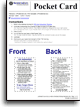 A "second line supervisor" is broadly defined as:
"Anyone that manages anyone that manages anyone"
Included with the Systems2win Lean Training templates are templates that makes it easy to quickly make your own TWI Pocket Cards.
The Systems2win J2 Pocket Card for Second Line Supervisors contains succinct reminders of what a Change Agent needs for success summarized on a credit-card-sized pocket card that can be easily personalized with the success factors that your company believes are most important.
You can easily personalize your company's TWI Pocket Cards for your own best practices,then print, cut out, laminate, and distribute to your second line supervisors as part of their managerial training.
Each card is perfectly sized to be the exact same size as a credit card.
In addition to the Pocket Card for Second Line Supervisors, there is also a Job Instructions Pocket Card, a Job Relations Pocket Card, and a Job Methods Pocket Card.
How to know if you have what it takes to be a Change Agent
Here's one acid test...
If you don't have the political power to persuade your company to provide your team leaders with the tools, training, and systems that they need for continuous improvement, then you are decidedly not a Change Agent.
Now that's okay, because you might still make a terrific Process Improvement Team Leader, but it is absolutely essential for an effective Team Leader to to recognize that his or her power is drawn from (and directly correlated to) the power of the Change Agent.
How to know if you have what it takes to be a Team Leader
Here's an acid test for a Team Leader...
If you are unable to use your personal persuasive skills to convince a high level executive or manager within your company to fulfill the role of the Change Agent, then you need to face the reality that you have zero chance of success as a Team Leader... at least within your current company or division. You might be a terrific Team Leader in a company or division that has a strong Change Agent to support you.
Have you ever seen the movie Men of Honor?
Where the first Black Navy diver in history takes 16 hours in freezing water to complete his final assembly test — because they cut his tool bag and strewed his tools all over the ocean floor?
If you have the drive and initiative to be a Team Leader, but find yourself in a company or division that won't even provide you with the tools you need to succeed...
then maybe it might be time to do your career (and your family and your mental and physical health) a huge favor, and face the possibility that you might have found yourself in the wrong career.
It might be time to start your search for some eagles you can fly with, instead of remaining with turkeys or vultures that cut your bag and strew your tools all over the ocean floor, and then hold you accountable for your poor performance.
Summary
For any project that will involve significant changes...
You need a Change Agent
(Don't start a major change project without one)
Training and Coaching
Consider Training and Coaching to support your teams to succeed
Schedule a Conference
Schedule a conference
to discuss your challenges
with an experienced lean advisor

Support
One huge benefit of owning your Systems2win templates is Support when you need it
Tell a Colleague
The right DMAIC tools
to Define, Measure, Analyze, Improve, and Control
the quality of ANY process
Why are we paying our people to re-invent tools, training, and systems that can be owned so easily?
Own Yours Now
If your organization has
not yet provided a license,
own yours now